The Quiet Desk: How Engineers Are Engineering Noise Itself Out of Your Workspace
Put on a pair of modern noise-canceling headphones and the world disappears. It's still a small miracle every time — the roar of a coffee shop, the drone of an airplane, the relentless hum of an open-plan office, all of it folding into a soft, manageable hush. ANC in headphones is mature technology now, almost boring in how reliably it works.
But here's the thing nobody's talking about loudly enough: the noise problem on your desk doesn't end at your ears. Every clack of a mechanical keyboard, every click of a mouse, every cooling fan spinning up under load — that's acoustic pollution bleeding into your calls, your recordings, your concentration, and your coworkers' patience. And a surprisingly sophisticated wave of engineering is coming for all of it.
The Mechanical Keyboard Problem
Let's start with the obvious offender. Mechanical keyboards are beloved by enthusiasts for their tactile feedback and satisfying actuation, but they're genuinely loud in ways that have become socially complicated in an era of video calls and home offices with thin walls. The clickiest switches — your Blues, your old-school Buckling Springs — can hit 60 to 70 decibels at the source. That's lawnmower-adjacent territory for the person sitting across from you on a Zoom.
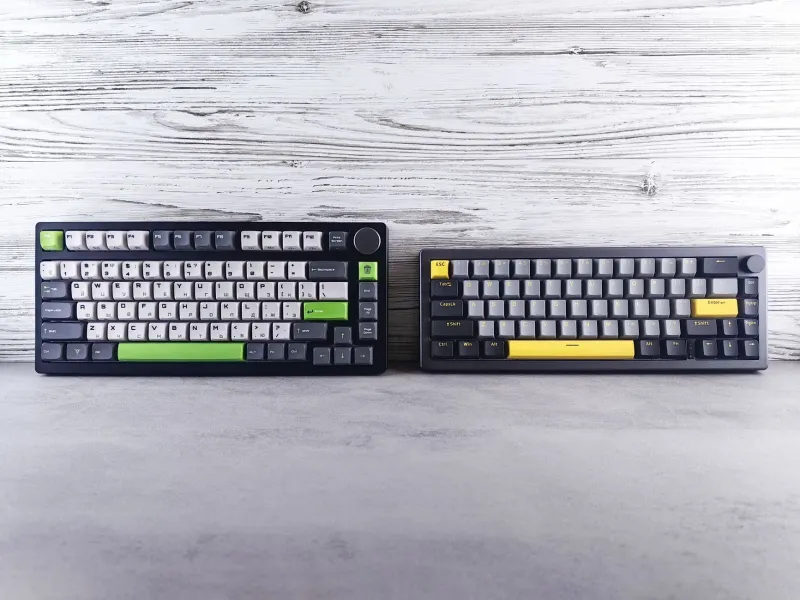
The keyboard community's response has been characteristically obsessive. A whole subculture of "silencing mods" has emerged, involving foam dampening layers inserted between the PCB and the plate, O-rings fitted around keycap stems, and switch lubing rituals that border on the meditative. But hardware manufacturers are now incorporating acoustic engineering at the design level rather than leaving it to aftermarket tinkerers.
Logitech's MX Mechanical line uses what the company calls "whisper-quiet" linear switches with built-in dampening. Keychron's K-series boards ship with pre-installed gasket mounts that decouple the typing plate from the chassis, absorbing vibration before it can radiate as sound. Some boutique keyboard makers are going further still, using computational acoustic modeling to tune the internal resonance characteristics of their cases before a single unit is produced.
The results are measurable. A well-dampened gasket-mount board with silent switches can operate in the 35 to 40 decibel range — quieter than a library reading room, and nearly inaudible to a microphone at normal desk distance.
Ultrasonic Tricks and Active Dampening
The more exotic end of this space is where things get genuinely interesting. Researchers at several universities and a handful of well-funded startups are experimenting with active acoustic cancellation applied not to incoming sound, but to outgoing mechanical noise at the source.
The principle borrows from ANC headphone technology but inverts it. Instead of generating anti-noise to cancel incoming sound at your ear, the system uses small actuators embedded in a device's chassis to generate counter-vibrations that cancel the mechanical noise before it escapes into the air. Early prototypes have demonstrated significant noise reduction in keyboards and hard drive arrays, and at least two startups are working toward commercial products.
Ultrasonic frequencies add another layer. Some emerging mouse designs use haptic actuators operating above the threshold of human hearing to provide click feedback while generating no audible sound whatsoever. You feel the click. You don't hear it. It's a subtle but genuinely uncanny experience — the tactile satisfaction of a physical button without any acoustic signature.
Microsoft's Surface lineup has quietly incorporated vibration-dampening materials between its keyboard layers for several generations. Apple's MacBook trackpad famously replaced a physical click mechanism with a Taptic Engine years ago — a move that was initially controversial but has since been widely copied because it works. The Force Touch trackpad produces no mechanical click sound at all; the sensation is entirely haptic.
Your Fan Is Lying to You
Keyboards and mice are the obvious targets, but thermal management is arguably the bigger noise problem in modern computing. A laptop under load can generate 40 to 50 decibels of fan noise — more than enough to be distracting and to bleed into microphone inputs. For content creators recording voiceovers or musicians laying down tracks, this is a genuine technical obstacle.
The engineering solutions here are diverse. Fanless designs using vapor chamber cooling or graphene heat spreaders eliminate mechanical noise entirely, at the cost of thermal headroom. Apple Silicon Macs — particularly the M-series MacBook Air — have made fanless operation viable for the majority of professional workloads, a remarkable achievement. The thermal efficiency gains from custom silicon have essentially solved the noise problem for a large swath of users without requiring any acoustic engineering at all.
For more demanding systems that still need active cooling, variable fan speed algorithms have become dramatically more sophisticated. Modern gaming laptops and workstations use machine learning to predict thermal load curves and pre-spin fans before a spike hits, keeping them in a quieter steady state rather than lurching between silent and screaming. It's not silence, but it's meaningfully less disruptive.
Liquid cooling, once the domain of extreme desktop builds, is migrating toward more mainstream form factors. Several compact workstation designs now use sealed liquid loops that operate at a near-inaudible murmur compared to air-cooled equivalents. The cost premium is real, but for audio professionals and serious streamers, it's often the right trade.
The Workspace as an Acoustic System
The most forward-thinking approach treats the desk not as a collection of individual devices but as an integrated acoustic environment. Startups like Silentium (no relation to the brand you might be thinking of) are developing active noise management systems that monitor the acoustic profile of an entire workspace and apply cancellation holistically — not just at one device, but across the whole room.
Desk pad and mat manufacturers are incorporating viscoelastic foam layers that absorb typing vibration before it can transmit through the desk surface. Monitor stands with dampened contact points prevent CRT-era resonance from spreading. Even cable management has acoustic implications — a tightly bundled cable run can transmit and amplify chassis vibration in ways that are surprisingly audible.
For remote workers who've spent the last few years conducting their professional lives from spare bedrooms and kitchen tables, this stuff isn't abstract. The quality of your audio environment directly affects how you're perceived in meetings, how deeply you can focus, and how much cognitive load you're burning just filtering out background noise. A genuinely quiet desk isn't a luxury — it's an ergonomic necessity that the industry is only now treating with the seriousness it deserves.
The headphones were just the beginning.