Fix It Yourself: The Repairability Revolution Quietly Dismantling Big Tech's Throwaway Empire
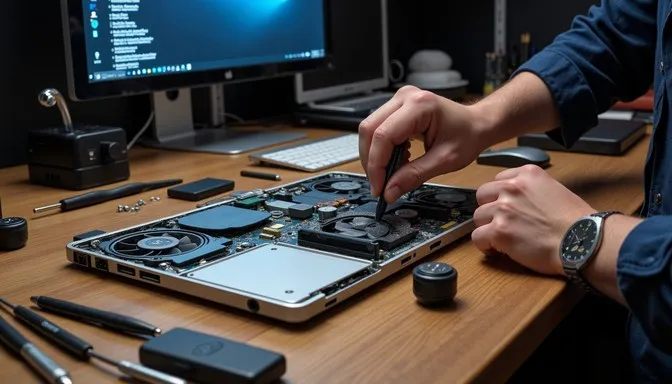
Photo: laptop disassembly modular components repair tools workbench, via images.stockcake.com
There's a drawer in most American homes that functions as a small electronics graveyard. Dead earbuds. A tablet with a cracked screen that was too expensive to fix and too functional-feeling to throw away. A laptop that slowed to a crawl after three years because the battery swelled and nobody sells a replacement. You know the drawer. You probably have the drawer.
For a long time, that drawer was just the cost of living in a gadget-saturated world. Planned obsolescence wasn't a conspiracy theory — it was a business model, quietly baked into every soldered-in battery and proprietary screw head. But something is shifting. A genuine repairability movement is picking up speed, and it's got momentum from directions that even the most skeptical tech observers didn't fully anticipate.
The Framework Effect
If you want a single company to point to as the proof-of-concept for repairable consumer hardware, Framework is your answer. The San Francisco-based startup launched its first modular laptop in 2021 with a genuinely radical pitch: every major component — the display, battery, keyboard, ports, even the mainboard — is designed to be swapped out by the person who owns it. No special tools. No voided warranty. No trip to an authorized service center.
The reception was, to put it mildly, enthusiastic. Framework sold out its initial batches almost immediately and has since expanded to multiple configurations and processor generations. More importantly, it proved something the industry had long insisted was impossible: that consumers actually want repairable devices, and will pay a fair price for them.
Framework's approach flipped the traditional upgrade cycle on its head. Instead of buying a whole new laptop every three or four years, owners can swap in a newer mainboard and keep the chassis, screen, and keyboard they already paid for. That's not just good for wallets — it's a meaningful dent in the roughly 50 million metric tons of e-waste the world generates annually, a number the US contributes to disproportionately.
Phones Are Harder — But Not Impossible
Smartphones are a tougher nut to crack. The engineering density required to pack a modern phone into a slim, waterproof slab makes modular design genuinely difficult. Remember Project Ara, Google's ambitious modular phone experiment that died in 2016? It's become shorthand for why modularity and mobile don't mix.
But the picture in 2024 looks different. Fairphone, the Dutch company that's been plugging away at repairable smartphones for over a decade, has iterated its way to a legitimately competitive device. The Fairphone 5 offers a repairability score that blows every major flagship out of the water, with user-replaceable batteries, screens, and cameras backed by a promised software support window of ten-plus years. It's not sold in the US yet — regulatory and carrier certification hurdles are real obstacles — but its existence matters as a proof point.
Closer to home, companies like iFixit have evolved from a repair manual website into a genuine hardware ecosystem, partnering with brands to supply official parts and tools. Their collaboration with Google to provide Pixel phone repair kits through official channels was a quiet landmark — a major OEM acknowledging that self-repair isn't a threat to their business.
Legislation With Actual Teeth
The other engine driving this shift is legal, not market-driven. Right-to-repair legislation has gone from a niche advocacy issue to a genuine policy priority at both the state and federal level. Minnesota passed a digital right-to-repair law in 2023. Colorado, California, and New York have enacted or are advancing similar measures. The FTC under recent administrations has made repair restrictions an explicit enforcement priority.
What these laws generally require is straightforward: manufacturers must make parts, tools, and documentation available to independent repair shops and individual consumers at fair prices. For companies that built entire service revenue streams on the assumption that repair would be expensive and inconvenient, that's a significant disruption.
Apple's response is instructive. After years of aggressive opposition to repair legislation and practices — including programming chips to detect non-Apple replacement parts — the company launched its Self Service Repair program in 2022. It's imperfect, clunky, and the rental tool kits weigh as much as a small refrigerator. But it exists, which would have seemed unthinkable five years ago.
Who's Actually Winning
Beyond Framework and Fairphone, a broader ecosystem of repairability-forward startups is finding its footing. Modular keyboard companies like ZSA (makers of the Moonlander and Voyager) have built loyal followings around the idea that you should be able to swap switches, replace keycaps, and reconfigure your setup indefinitely. The mechanical keyboard community, long a haven for tinkerers, has essentially pioneered consumer-hardware repairability as a lifestyle.
In the audio space, companies like Sennheiser have quietly maintained modular headphone lines for years — the HD 25 has been in production since 1988 and every part is still available. That kind of long-tail support is starting to look less like a niche quirk and more like a competitive advantage as consumers grow more skeptical of the upgrade treadmill.
Even in the EV space, the repairability conversation is heating up. Tesla's integrated, software-locked approach to vehicle repair has generated enormous friction with independent shops. Startups like Rivian have made more conciliatory noises about third-party repair access, sensing an opening.
Why This Actually Matters
The repairability movement isn't just about saving money on a cracked screen, though that's a real benefit for real people. It's about a fundamental reorientation of the relationship between consumers and the objects they own. The throwaway model assumes that you're essentially leasing your devices — that they exist on a corporate timeline, not yours.
Modular, repairable design pushes back against that assumption. It says the thing you bought is yours, actually and completely, and that you have the right to maintain it, modify it, and extend its useful life as long as you see fit.
For early adopters and tech enthusiasts specifically, there's something even more appealing here: the ability to upgrade incrementally rather than wholesale. A Framework user who swaps in a new mainboard while keeping their existing peripherals is doing something philosophically interesting — they're treating their laptop less like a consumer product and more like a living system.
The throwaway era isn't dead yet. Plenty of major manufacturers are still gluing batteries in place and shipping proprietary screws. But the direction of travel has genuinely changed. The drawer full of dead gadgets is starting to look less like an inevitability and more like a choice — and more Americans are deciding they'd rather make a different one.