Flat Screens Are Finished: The Spatial Display Revolution Already Happening Without You
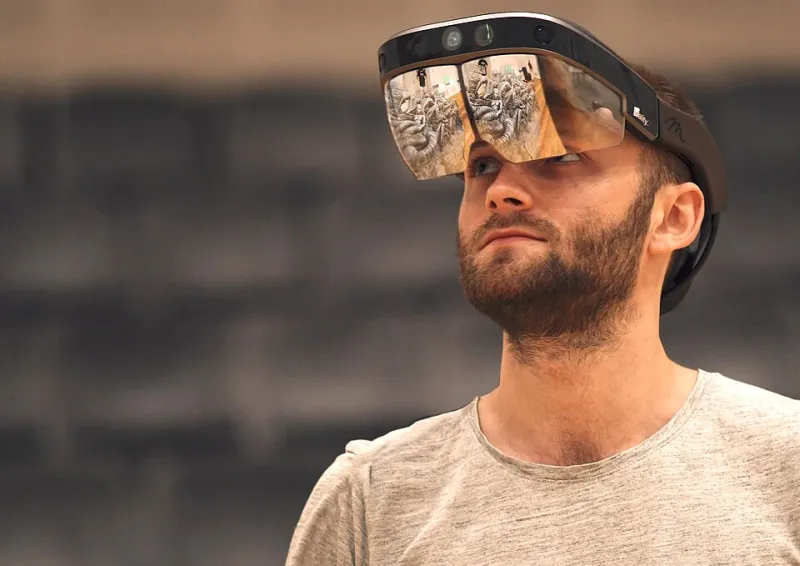
Photo: Maxibu, CC BY-SA 4.0, via Wikimedia Commons
Let's be honest: the monitor sitting on your desk right now is basically a really expensive picture frame. It's flat, it's fixed, and it has absolutely no idea where you are in space. For the last 40 years, we've just kind of... accepted that. But a growing number of companies — and the engineers quietly working inside them — think that's about to change in a dramatic, irreversible way.
We're not talking about OLED upgrades or higher refresh rates. We're talking about the end of the flat display paradigm altogether.
The Convergence Nobody Announced
Three distinct technology threads are braiding together right now, and the result is something that's genuinely hard to wrap your head around if you're still staring at a rectangle all day.
First, AR glasses have crossed a critical usability threshold. Devices like Meta's Ray-Ban smart glasses and the early developer builds coming out of startups like Brilliant Labs and Even Realities are no longer novelty items — they're functional tools that people are actually wearing for extended periods. Second, spatial computing platforms — Apple Vision Pro being the most visible example in the US — have proven that users will adapt to three-dimensional interfaces faster than most analysts predicted. And third, holographic display technology, while still expensive and mostly enterprise-facing, has matured enough that companies like Looking Glass Factory are shipping actual products to design studios and medical facilities.
None of these threads alone kills the monitor. But together? That's a different conversation.
What Enterprises Already Know That You Don't
Here's the part that should make you sit up: the transition away from flat screens isn't some distant future event. It's already happening in corporate environments, and it's moving faster than consumer tech press is covering it.
Architectural firms in New York and Los Angeles are using spatial displays to walk clients through building designs in real scale — not on a screen, but projected into the actual room. Surgical planning teams at major hospital networks are using volumetric displays to examine 3D imaging data before operations. And industrial design shops, particularly in the automotive sector, have been using mixed-reality headsets for CAD review for the better part of three years.
The workflow shift is significant. Designers who've made the jump describe it as the difference between looking at a photograph of a sculpture and actually holding the sculpture. "Once you've reviewed a product model in spatial context, going back to a flat screen feels like you're missing information," one product lead at a mid-sized Detroit-based automotive supplier told us. "It's not a preference thing anymore — it's a capability thing."
The Hardware Getting There
So what's actually powering this shift?
On the glasses side, the weight and battery life problems that killed Google Glass aren't fully solved, but they're dramatically improved. New waveguide lens technology — the optical trick that lets digital images appear to float in your field of view — has gotten sharper and wider in field of view. Companies like Lumus and Vuzix are supplying optics components to a wave of OEM manufacturers who are building enterprise-grade AR devices that don't look like science fair projects.
On the holographic end, light field displays — which create genuine 3D images without requiring headgear — are still bulky and expensive, but the price curve is bending. Looking Glass Factory's latest 65-inch portrait display runs around $30,000. That sounds steep until you realize their first large-format unit was nearly three times that price just four years ago.
And then there's the software layer. Spatial operating systems are getting real. Apple's visionOS has already attracted serious developer interest. Meta's Horizon OS is evolving beyond gaming. And open platforms like Monado (the open-source OpenXR runtime) are giving smaller developers the tools to build spatial apps without betting everything on one walled garden.
The Consumer Lag Is Real — But It Won't Last Forever
Here's where things get interesting from a consumer perspective. Most people reading this are nowhere near ready to ditch their monitors. The price of entry is still high, the content ecosystem is still thin, and frankly, spatial interfaces have a learning curve that casual users aren't eager to climb.
But that's how every major display transition has worked. Flat-panel TVs spent years as expensive executive flex items before Walmart started stacking them in the electronics aisle. 4K monitors were a creative professional luxury before they became the default. The pattern is consistent: enterprise adoption funds the R&D, manufacturing scales, prices fall, consumers arrive.
The timeline for spatial displays hitting mainstream consumer price points — somewhere around the $300-500 range for a genuinely capable AR device — is probably five to seven years out. But the groundwork is being laid right now, and the companies that are going to win that market are already in motion.
What Happens to Your Monitor in the Meantime
Nothing dramatic, honestly. Your 27-inch 4K display isn't going anywhere this year or next. But the writing is starting to appear on the wall — or rather, floating in the air just in front of it.
Monitor manufacturers aren't oblivious. Samsung and LG are both investing in display technologies that blur the line between flat and spatial. Micro-LED arrays that can be curved, folded, or wrapped around surfaces are already in production at scale. These aren't spatial displays in the truest sense, but they're hedging bets in an interesting direction.
The more telling signal is where the software attention is going. When major productivity suites start building spatial-native interfaces — and they are, quietly — the hardware will follow consumer demand in a hurry.
Flat screens aren't dead yet. But they're definitely getting their affairs in order.