One Millisecond From Presence: The Latency War That Will Make or Break Virtual Reality
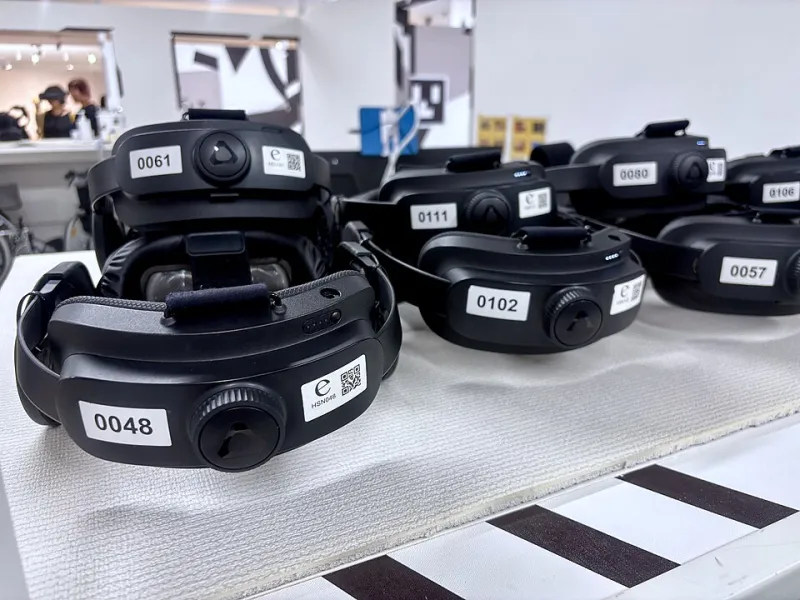
Photo: Kyu3a, CC BY-SA 4.0, via Wikimedia Commons
Ask anyone who's spent serious time in VR headsets — not a five-minute demo at a Best Buy kiosk, but real, extended sessions — and they'll tell you something that surprises people who've only read the spec sheets. Resolution isn't what breaks the illusion. Refresh rate isn't what breaks the illusion. The thing that yanks you out of a virtual world and reminds your brain that you're actually standing in your living room wearing a foam-padded screen is latency. Specifically, the gap between when you move your head and when the world around you catches up.
That gap, measured in milliseconds, is the last great technical barrier between current VR and something that deserves to be called genuine presence. And right now, some of the most interesting engineering in consumer technology is happening in the fight to close it.
Why Your Brain Is the Harshest Critic
Human perception is remarkably tolerant of many kinds of visual imperfection. We accept compressed video, low polygon counts, and flat lighting in games without our immersion collapsing. But motion-to-photon latency — the time between a physical head movement and the corresponding update in the visual field — triggers something much more fundamental.
The vestibular system, the inner-ear mechanism that tracks your head's orientation in space, operates on an extremely tight feedback loop. It expects the visual world to confirm what it's feeling in real time. When there's a mismatch — when you turn your head and the virtual world lags even 20 milliseconds behind — the conflict between vestibular input and visual input produces a response that ranges from mild unease to full-on nausea. It's the same mechanism behind car sickness, and it's not something you can train yourself out of.
The threshold researchers generally cite for comfortable VR is somewhere around 20 milliseconds end-to-end. The sweet spot for genuinely convincing presence is thought to be closer to 7 to 11 milliseconds. The absolute theoretical floor, based on human perceptual limits, is somewhere below 3 milliseconds. Current high-end headsets like the Meta Quest 3 and PlayStation VR2 are operating in the 15 to 22 millisecond range under optimal conditions. Better than early consumer VR, but still perceptibly short of convincing.
The Hardware Side of the Fight
Chasing those last few milliseconds is forcing hardware engineers into some genuinely exotic territory. Display technology is one front. Most current VR headsets use LCD or OLED panels running at 90 to 120Hz. But microLED panels, which can switch individual pixels on and off in microseconds rather than milliseconds, are starting to appear in prototype headsets. The response time advantage is significant — microLED effectively removes display latency as a meaningful variable.
On the rendering side, foveated rendering has become a key tool. By tracking where the user's eyes are actually pointing and rendering only that region at full resolution — letting the periphery run at lower fidelity — headsets can dramatically reduce the computational load and the time required to generate each frame. Apple's Vision Pro uses eye tracking and foveated rendering extensively. The technique sounds like a cheat, but the human visual system's own acuity falloff in peripheral vision means it's essentially invisible when implemented well.
Predictive head tracking is another lever. Rather than waiting for sensor data to confirm a head movement and then rendering the updated frame, newer algorithms attempt to predict where the user's head will be when the next frame is displayed and pre-render accordingly. Meta calls their version Predictive Head Tracking; other manufacturers have their own implementations. When the prediction is right, it effectively eliminates the perception of lag. When it's wrong, it can briefly feel worse — a trade-off that requires very high prediction accuracy to pay off.
Edge Computing and the Network Latency Problem
Standalone headsets like the Quest 3 do all their rendering on-device, which limits graphical fidelity but keeps the latency loop tight. PC-tethered VR can push much higher visual quality, but introduces cable or wireless transmission latency into the chain. Cloud-rendered VR, which promises console-quality graphics streamed to a lightweight headset, has to solve a latency problem that's fundamentally different from the hardware challenge.
Over a standard home broadband connection, round-trip network latency is typically in the 20 to 50 millisecond range. Stack that on top of encoding, transmission, decoding, and display latency and you're well into nausea territory. This is why every major cloud gaming VR project has so far disappointed.
The theoretical solution is edge computing — moving rendering infrastructure physically close to users, reducing the speed-of-light travel time for data packets. Some telecom companies are experimenting with edge compute nodes embedded in 5G base stations, a configuration that could theoretically reduce network round-trip times to single-digit milliseconds. For densely populated urban areas, this is plausible within a few years. For the suburban and rural US, it's a much longer road.
6G research, still largely in the academic and standards-body phase, targets air interface latencies below 1 millisecond — a number that would effectively make wireless transmission latency negligible in the VR context. Researchers at NYU Wireless and several national labs are working on millimeter-wave and terahertz frequency approaches that could make this real, though commercial 6G deployment is generally expected no earlier than 2030.
What Indie Developers Know That AAA Studios Don't
Here's the perspective that tends to get lost in the hardware conversation: some of the most compelling VR experiences being made right now come from small studios that have leaned into latency constraints as a design challenge rather than treating them as a bug to be patched.
Developers building for standalone headsets have learned to design gameplay around the hardware's actual capabilities — shorter draw distances, stylized graphics, interaction models that don't require fast-twitch precision. The result, in the best cases, is experiences that feel native to VR rather than ports of flat-screen sensibilities. Games like Lone Echo 2 and Asgard's Wrath 2 demonstrate that you can achieve deep immersion at current latency levels if you build around the medium's actual characteristics.
The indie studios most focused on the latency problem tend to be the ones building social VR and collaborative experiences, where the sense of shared presence with another person is the core value proposition. When someone else's avatar moves with a perceptible lag, the illusion of being in the same space collapses immediately. Several small studios working in this space have built custom networking stacks specifically optimized for head and hand tracking data, prioritizing that stream above everything else in their architecture.
The Real Prize
Latency isn't a glamorous problem. It doesn't photograph well. You can't put it in a marketing headline the way you can put "4K per eye" or "110-degree field of view." But every engineer who's worked seriously on VR presence knows that it's the variable that matters most.
The headsets coming in the next two to three years — from Meta, Sony, Apple, and a wave of well-funded challengers — are all targeting that sub-10-millisecond threshold as their primary engineering objective. When someone cracks it consistently, across a range of content and use cases, the experience will be qualitatively different from anything available today. Not marginally better. Different in kind.
That's the moment VR stops being a technology people try and start being a technology people live in. Everything else is just waiting for the world to catch up.