Buttons Are Becoming Extinct — And Nobody's Filing a Protest
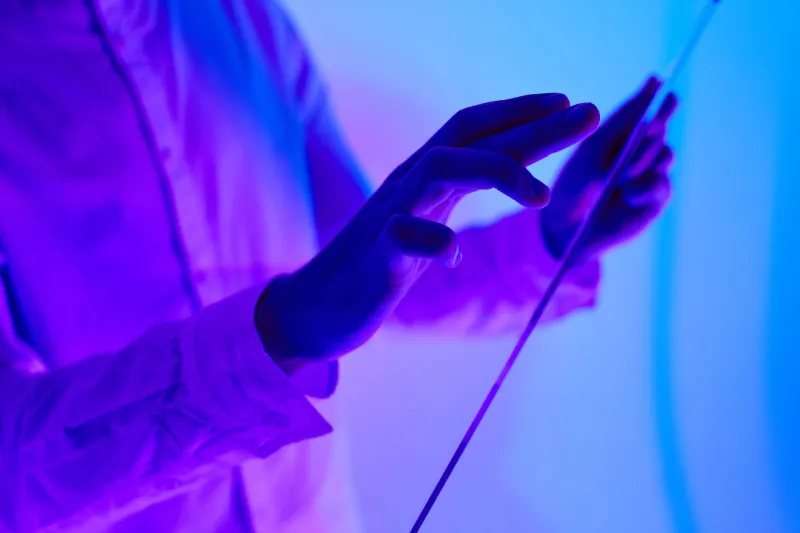
Think about the last time you adjusted your car's volume by reaching for a physical knob. Or turned off a light by flipping an actual switch. For a lot of people, those moments are already becoming nostalgic — the tech equivalent of rewinding a VHS tape. The interface as we've known it for decades is being quietly dismantled, and in its place, something far stranger and more seamless is taking shape.
We're not just talking about Siri getting better at understanding your accent. This is a fundamental rethinking of how humans interact with machines — a shift from physical input to multimodal communication that reads your voice, your hands, your eyes, and eventually your intentions.
The Touchscreen Was Always a Compromise
Here's a take that might ruffle some feathers: the touchscreen was never the destination. It was a waypoint. When Apple launched the original iPhone in 2007, the touchscreen felt like magic — a glass slab that responded to your fingers felt impossibly futuristic. And it was, at the time. But glass and capacitive sensors were always a workaround for the bigger goal: making technology that responds to people naturally, without requiring them to learn a new physical language.
The problem with touchscreens is that they demand your full visual attention. You can't swipe through your playlist while keeping your eyes on the road, not safely anyway. You can't control a smart home interface when your hands are covered in flour. The touchscreen is brilliant for what it is, but it's fundamentally a 2D solution for an increasingly 3D world.
That's where spatial computing steps in.
Spatial Computing Isn't Just a Buzzword Anymore
Magic Leap has had its share of hype cycles and hard landings, but the company's latest enterprise-focused hardware represents something genuinely interesting: a bet that overlaying digital information onto physical space isn't just a gimmick — it's the next logical layer of computing. When your interface exists in the space around you rather than on a flat screen, buttons become redundant. You reach out, you gesture, you look at something to select it.
Apple's Vision Pro brought this concept to a mass-market audience, and whatever you think about the price tag, the interaction model it introduced is hard to argue with once you've used it. Eye tracking combined with subtle pinch gestures creates a control system that feels almost telepathic. There's no stylus, no controller, no touchpad — just you, moving through a digital environment the way you move through a physical one.
The learning curve is real. But so was the learning curve for the first touchscreens.
Humane's Stumble and What It Taught the Industry
Not every attempt at interface reinvention lands gracefully. Humane's AI Pin was supposed to be the device that proved you didn't need a screen at all — a wearable that projected information onto your palm and responded entirely to voice and gesture. The vision was genuinely compelling. The execution, by most accounts, was not.
But here's the thing about Humane's stumble: it didn't kill the idea. If anything, it clarified the problem. The company was right that the next interface wouldn't look like a phone. They just underestimated how much the transition would depend on latency, reliability, and the invisible polish that makes any new interaction model feel trustworthy rather than frustrating.
The startups that watched Humane's rollout are now building with a different priority stack. Less flash, more function. Companies like Tab and Rewind are embedding AI-driven voice interfaces into hardware that doesn't ask you to abandon your existing workflows overnight — they layer on top of them.
Haptics: The Invisible Dimension of the New Interface
One piece of the post-button world that doesn't get enough credit is haptic feedback. When you remove physical keys and dials, you lose tactile confirmation — the satisfying click that tells your fingers something happened. Next-gen haptic systems are working to fill that gap in ways that go well beyond the buzz-buzz of a phone notification.
Companies like Immersion and HaptX are developing feedback systems that can simulate texture, resistance, and even temperature across a range of surfaces. For gesture-based interfaces, this matters enormously. If you're reaching out to "press" a virtual button in augmented space, the experience only feels natural if your hand receives some signal that contact was made. Without it, you're just waving at air.
The military and medical industries have been quietly using advanced haptic interfaces for years — surgeons performing remote procedures, pilots training in simulators. Consumer tech is finally catching up, and the results are starting to feel less like a tech demo and more like a genuine shift in how interaction works.
Why This Is Happening Now
There are a few converging forces making 2024 and 2025 the inflection point for interface evolution. Processing power has gotten cheap enough that real-time gesture recognition and voice parsing can happen on-device, without the cloud lag that made earlier attempts feel sluggish. Sensor miniaturization means cameras and depth sensors can fit into form factors that don't look like you're wearing a motorcycle helmet. And AI models have gotten good enough at understanding context that voice commands don't need to be robotically precise anymore — you can speak the way you actually speak.
Add to that a cultural shift: the generation of users who grew up swiping is now comfortable enough with technology to want it to get out of the way. The best interface, as the design world has been saying for years, is no interface at all. Or at least, no interface you have to consciously think about.
What Comes Next
The humble button isn't going to vanish overnight. There will always be use cases where physical input is the safest, most reliable option — emergency systems, industrial controls, accessibility tools for users who need tactile certainty. But as a default? As the thing you reach for first? Its days are genuinely numbered.
The next few years are going to look like a messy, exciting transition period. Some experiments will fail publicly. Some will quietly become the new normal before most people notice they've changed. If history is any guide, the interface that replaces buttons won't feel radical once it's arrived — it'll just feel obvious.
Which is exactly how you know it's the right one.