Screens Are So Last Decade: The Ambient Computing Wave Coming to Swallow Your Phone
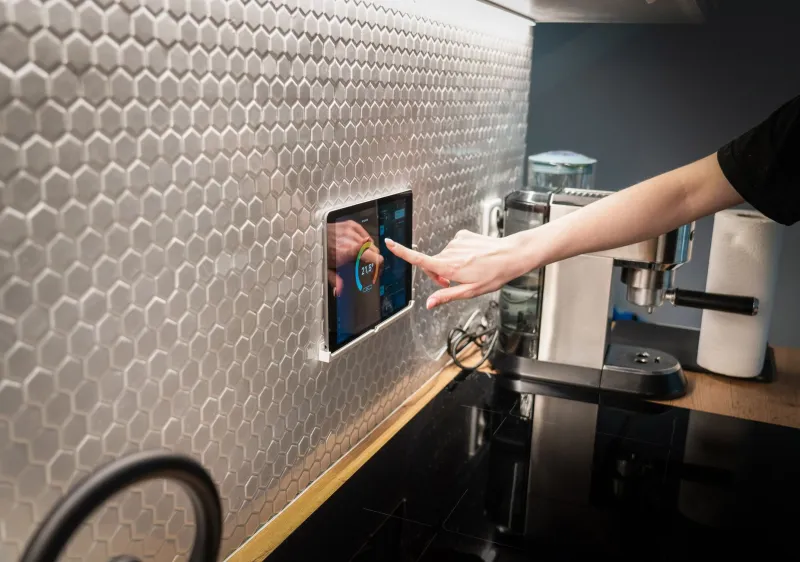
Let's be honest for a second. The smartphone was never the destination — it was just the best stopgap we had. A glowing rectangle you stare into dozens of times a day, tapping and swiping and squinting. It's remarkable technology, sure. But it's also kind of exhausting.
Something is shifting. Quietly, almost imperceptibly, a new computing paradigm is assembling itself in labs, garages, and well-funded startup offices across the country. It doesn't have a catchy product name yet. It doesn't come in a box at Best Buy. But ambient computing — the idea that processing power should dissolve into your environment rather than concentrate in a single handheld device — is moving faster than most people realize.
And when it arrives in full force, it's going to make your phone look about as essential as a pager.
What "Ambient" Actually Means (It's Not Just Smart Speakers)
When most people hear "ambient computing," they think of Alexa sitting on a kitchen counter, waiting to set a timer. That's ambient computing the way a flip phone is a smartphone — technically related, but missing the entire point.
True ambient computing means your environment becomes the interface. Computation happens around you, responding to context — where you are, what you're doing, who you're with, what you said three minutes ago — without requiring you to pull anything out of your pocket or tap a single button.
Think spatial audio that shifts as you move through a room. Projections that appear on whatever surface is nearest. Wearables that read biometric signals and adjust your environment before you've consciously registered a preference. Neural input systems that translate intent into action without physical interaction at all.
This isn't science fiction. Pieces of it are already shipping.
The Founders Who Are Done Waiting for Big Tech
Some of the most interesting work in this space isn't coming from Apple or Google. It's coming from founders who got tired of iterating on the same screen-centric assumptions and decided to start from scratch.
Take the wave of startups building what insiders are calling "ambient-first" ecosystems — platforms designed from the ground up to operate without a primary display. These teams are rethinking everything: input methods, output modalities, even the basic question of where computation should live.
One recurring theme across conversations with these builders is frustration with what they call the "screen gravity" problem. Existing operating systems, app stores, and developer tools all assume a screen is the center of the experience. Building around that assumption, they argue, is like trying to design a car by starting with the horse.
Instead, they're anchoring their architectures around sensors, spatial awareness, and what one founder described as "proactive context" — the idea that a well-designed system should anticipate your needs based on environmental signals, not wait for you to express them through a touchscreen.
Neural Input Is Closer Than the Hype Suggests
The most radical piece of the ambient computing puzzle is also the one generating the most skepticism: neural interfaces. And yeah, the Neuralink coverage has made everyone a little gun-shy about believing the timelines.
But here's the thing — you don't need a chip in your brain to make neural-adjacent input work. Non-invasive electromyography (EMG), which reads electrical signals from muscle movements, is already being used in prototype wearables to translate subtle hand gestures — or even imagined gestures — into device commands. Meta's been quietly developing EMG wristbands. Startups like Ctrl-labs (acquired by Meta) were doing serious work in this space years ago.
The trajectory is clear: input is getting more invisible. First we went from keyboards to touchscreens. The next jump is from touchscreens to gesture, gaze, voice, and eventually neural signals — layered together into a system that just knows what you mean.
When input becomes invisible, the screen becomes optional. And when the screen becomes optional, the smartphone's entire reason for existing starts to erode.
Why Your Phone Is the Mainframe of 2035
Here's a useful historical parallel. In the 1970s, mainframes were how serious computing got done. They were powerful, centralized, and completely dominant. Then personal computers came along and distributed that power to individuals. Then smartphones concentrated it again into a pocket-sized form factor.
Ambient computing is the next redistribution — except this time, the power scatters outward into the environment itself. Your home, your car, your clothing, your workspace. Processing happens at the edge, in the cloud, and on low-power chips embedded in objects you'd never think of as computers.
The smartphone doesn't disappear overnight. Mainframes didn't either — they just stopped being the center of gravity. Your phone becomes one node among many, rather than the hub everything routes through. That's a massive shift in how hardware gets designed, how software gets built, and how companies make money.
For early adopters, it's also an enormous opportunity to get ahead of the curve before the mainstream catches on.
The Real Obstacles Nobody's Talking About
It would be irresponsible to hype this without acknowledging the serious friction points. Ambient computing faces some genuinely hard problems.
Privacy is the obvious one. An always-on, environment-aware system is, by definition, always watching and listening. The data it needs to function — your location, your habits, your biometrics, your conversations — is extraordinarily sensitive. The companies building these systems are going to have to answer some very uncomfortable questions about where that data lives and who can access it. Given the current regulatory climate in the US, that's not a conversation that's going to stay quiet for long.
Then there's the battery and compute problem. Truly ambient systems require sensors and processors running continuously, often across multiple devices simultaneously. Power efficiency has improved dramatically, but always-on ambient awareness at scale is still a significant engineering challenge.
And don't underestimate the behavior change problem. People are deeply habituated to screens. Convincing mainstream users to trust a system they can't see or tap is a UX mountain that even the best-funded teams haven't fully figured out how to climb.
This Is the Shift Worth Watching
For all the noise about AI features getting baked into smartphones, the more interesting story is what happens when AI stops needing the phone at all. When the model lives at the edge, in your earbuds or your glasses or the walls of your apartment, and the interface becomes the world around you — that's when the real disruption lands.
We're not there yet. But the foundational pieces — spatial computing hardware, low-power AI chips, non-invasive input methods, mesh sensor networks — are converging faster than the smartphone era's early skeptics would have predicted.
Keep your eyes open. Or better yet, stop staring at a screen long enough to notice what's building around you.