The Volunteer Army Building Better Tech Than Google's Entire R&D Budget
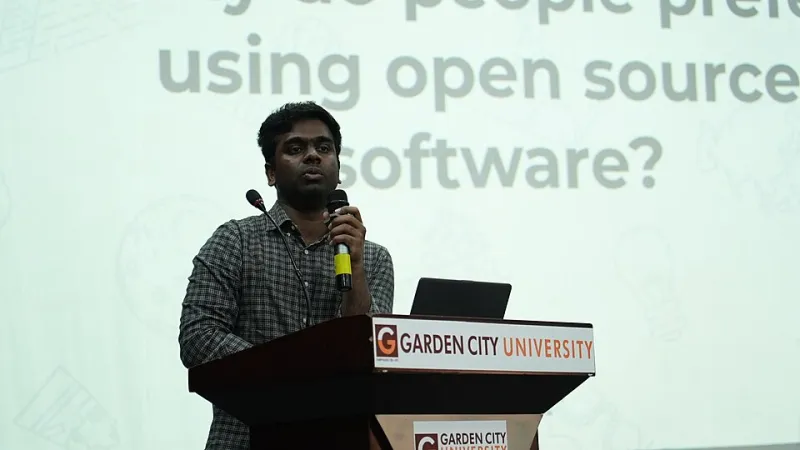
Photo: Pugal202, CC BY 4.0, via Wikimedia Commons
Somewhere in a Discord server right now, a retired aerospace engineer in Ohio, a grad student in Bangalore, and a self-taught programmer in São Paulo are collaborating on a robotic arm control system that's better than anything you can buy off the shelf. Nobody's getting paid. Nobody's managing them. And they're shipping faster than teams with million-dollar budgets.
This is not a feel-good anomaly. It's becoming the norm.
Open-source development has always punched above its weight in software — Linux runs most of the internet, after all. But something different is happening now. The open-source model is jumping off the screen and into physical reality: robotics, materials science, biotech, AI hardware design. And the results are genuinely shocking the people who spent decades assuming that cutting-edge innovation required cutting-edge funding.
OpenBot: Robotics Without the Price Tag
Robotics has long been the domain of well-funded university labs and corporate giants like Boston Dynamics. The barrier to entry wasn't just expertise — it was the $50,000 to $500,000 price tag on anything serious.
Then projects like OpenBot came along and blew that model up.
OpenBot, developed initially by Intel Labs researchers but rapidly expanded by a global community, turns a $50 Android smartphone into the brain of a fully functional autonomous robot. The chassis can be 3D-printed. The software is free. The community has since extended it far beyond the original vision, adding navigation algorithms, obstacle avoidance systems, and multi-robot coordination capabilities that rival proprietary platforms costing orders of magnitude more.
The key insight isn't just that it's cheap — it's that thousands of contributors stress-tested and improved the system in environments that no single corporate lab could replicate. Desert heat, urban debris, warehouse floors, farm terrain. The diversity of the community became the diversity of the testing ground.
Open Source Biology and the DIY Drug Discovery Revolution
If robotics feels tangible, what's happening in biotech is outright surreal.
The Open Source Malaria consortium — a decentralized network of chemists, biologists, and data scientists spread across multiple continents — has been conducting drug discovery research in a completely transparent, collaborative environment. Every experiment, every failure, every data point is public. Anyone can contribute. And they've made genuine progress on compounds that traditional pharmaceutical pipelines, optimized for profitability, had no incentive to pursue.
This matters enormously in the US context, where drug pricing and research prioritization are constant political flashpoints. When the research is open, the compounds can't be locked behind patents that price out the people who need them most.
Similarly, the Opentrons project has put liquid-handling robots — the kind that automate biological experiments — within reach of community labs and small research teams by open-sourcing both the hardware designs and the software. Labs that previously couldn't afford automation are now running experiments that would have required a major university budget five years ago.
OpenFOAM and the Materials Science Underground
Materials science might sound like the least glamorous frontier, but it's where some of the most consequential open-source work is quietly happening.
OpenFOAM is a computational fluid dynamics platform — essentially software that simulates how materials, fluids, and gases behave under physical conditions. It's the kind of tool that aerospace companies and automotive manufacturers once paid enormous licensing fees to access. Now it's free, and a global community of engineers has extended it into applications the original developers never imagined: designing better battery electrolytes, modeling heat dissipation in next-gen chips, even simulating novel building materials for more energy-efficient construction.
The community around OpenFOAM has produced research that's been cited in peer-reviewed journals, adopted by national laboratories, and used in products you've almost certainly interacted with. No corporate sponsor required.
Why Big Tech Can't Win This Fight
Here's the uncomfortable truth for the megacorps: the open-source model has structural advantages that money genuinely can't buy.
First, motivation. Volunteer contributors are solving problems they actually care about. A corporate engineer working on a project assigned by a product manager has a fundamentally different relationship to the work than someone who chose it out of pure interest. Passion is not a trivial variable in creative problem-solving.
Second, diversity of perspective. A global, self-selected community of contributors brings cognitive diversity that's nearly impossible to hire for. The person who cracks a materials science problem might be a mechanical engineer who also happens to have a background in cooking — a combination no recruiter would think to search for.
Third, and most importantly, there's no ceiling. A corporate R&D team has headcount, budget cycles, and quarterly priorities. An open-source project can absorb contributions from ten thousand people if the problem is compelling enough. The scaling is essentially unlimited.
Big Tech knows this, which is why companies like Google, Meta, and Microsoft have invested heavily in open-source projects — partly to benefit from community contributions, and partly to maintain influence over the direction of platforms they can't afford to cede entirely.
The Catch (There's Always a Catch)
Open-source isn't a magic wand. Projects die when core contributors burn out. Governance is messy. Security vulnerabilities can fester when nobody's officially responsible for auditing the codebase. And the leap from brilliant GitHub repository to actual product in people's hands still requires resources that many open-source communities struggle to assemble.
But the trajectory is undeniable. In field after field, the most interesting work is happening in the open — not behind NDAs, not in secretive corporate labs, not gatekept by venture capital timelines.
The volunteer army isn't going anywhere. And right now, they're winning.