Your Body, Decoded: The New Wave of Biosensors That Turn Skin Into a Dashboard
Your Apple Watch can tell you your heart rate. Your Oura Ring can make a reasonable guess at how well you slept. These are genuinely useful data points, and the health wearable market has built a multi-billion-dollar industry on them. But they're also, in the context of what's actually possible right now, almost quaintly limited — like judging a car's mechanical health by listening to the engine.
A new generation of biosensing technology is doing something fundamentally different. It's reading the chemistry of your body in real time — the actual molecular signals that precede illness, performance decline, and mental state shifts — and turning that information into actionable data. The devices doing this range from sophisticated skin patches to implantable sensors the size of a grain of rice. And they're creating a product category that sits uncomfortably, excitingly, at the exact intersection of consumer tech and clinical medicine.
Beyond Heartbeats: What "Real" Biometrics Actually Look Like
Heart rate variability is a proxy. Sleep stage detection is an inference. What the next generation of biosensors is chasing is primary data — direct measurement of the biomarkers your body actually produces rather than the indirect signals that hint at them.
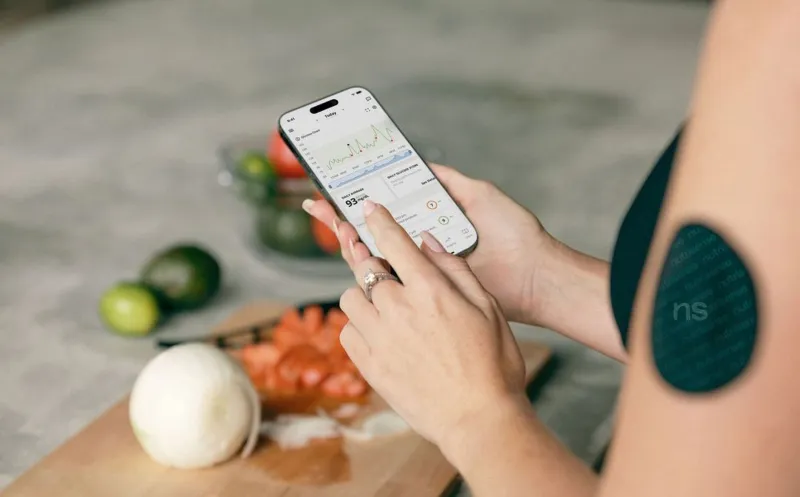
Glucose is the most commercially mature example. Continuous glucose monitors (CGMs) like those from Dexcom and Abbott have been FDA-approved for diabetic patients for years. But the last 18 months have seen an explosion of consumer-facing CGM products aimed squarely at non-diabetic Americans who want to understand how their diet and lifestyle affect their blood sugar in real time. Levels Health built a software platform on top of existing CGM hardware, turning raw glucose data into personalized dietary coaching. Stelo, Abbott's over-the-counter CGM launched in 2024, dropped the prescription requirement entirely — a watershed moment for the category.
But glucose is just the beginning. Research labs and well-funded startups are in active development on sensors that can measure cortisol (your primary stress hormone), lactate (critical for athletic performance), uric acid (linked to gout and metabolic syndrome), and even interleukins — inflammatory markers that can signal immune system activation days before you feel sick.
Epsilon3 spinout Eccrine Systems has been developing sweat-based sensors that pull these markers from perspiration continuously and non-invasively. The military was an early customer — soldiers whose cortisol and hydration levels can be monitored in real time are genuinely safer in the field. The consumer applications are obvious and coming fast.
The Implantable Frontier
If sweat sensors feel like science fiction, implantables are going to require a moment to sit with. Because they're real, they're here, and the regulatory and ethical frameworks surrounding them are still very much works in progress.
Synchron has made headlines for its Stentrode device — a brain-computer interface delivered via blood vessels rather than open-skull surgery — that's allowed paralyzed patients to control computers with their thoughts. That's the dramatic end of the spectrum. But there's a quieter implantable revolution happening in the metabolic health space.
Glucose implants like those being developed by Senseonics can sit under the skin for up to 365 days, continuously monitoring blood chemistry without the daily sensor changes required by patch-based CGMs. Biolinq is working on a minimally invasive micro-needle array that sits just beneath the skin surface and can read multiple biomarkers simultaneously. Profusa has developed injectable biosensors — actual hydrogel threads injected into tissue — that integrate with the body at the cellular level and communicate data wirelessly.
The pitch for implantables isn't vanity. It's accuracy and continuity. A sensor that lives inside the body reads the signals your biology is actually producing, not the attenuated versions that make it through skin and sweat. For managing chronic conditions, that precision gap is clinically meaningful.
Neurochemistry: The Last Frontier (For Now)
Here's where the conversation gets genuinely strange. A handful of research groups and early-stage companies are working on sensors capable of detecting neurochemical activity — dopamine, serotonin, norepinephrine — in real time. The applications for mental health monitoring and treatment are profound. So are the privacy implications.
Neurosity and Emotiv have been selling EEG-based headsets for years, but EEG is a blunt instrument — it detects aggregate electrical activity across brain regions rather than specific chemical signals. The next step, which is still mostly in academic labs but moving toward commercial viability, involves electrochemical sensors placed closer to the source. Some research is being done with minimally invasive probes; other approaches use advanced signal processing to infer neurochemical states from peripheral biomarkers.
For someone managing depression, anxiety, or ADHD, a device that could tell you when your dopamine regulation is dysregulated — before you consciously feel the crash — is potentially transformative. The therapeutic applications are being taken seriously by clinical researchers. But the consumer tech version of that same device, owned by a company with a terms-of-service agreement and a data monetization strategy, is a different conversation entirely.
The FDA Is Running to Keep Up
The regulatory picture is complicated and evolving fast. The FDA's Digital Health Center of Excellence has been working to create clearer pathways for software-as-a-medical-device and connected biosensors, but the pace of commercial development is consistently outrunning the agency's review capacity.
The over-the-counter CGM approval for Stelo was a significant precedent — it signaled regulatory comfort with certain classes of continuous biosensing moving outside the traditional prescription model. But for more complex biomarkers, especially anything touching neurological function, the approval pathway remains long, expensive, and uncertain. Companies are navigating this by launching as "wellness" devices rather than medical ones, a category that carries far fewer regulatory obligations but also far less clinical credibility.
That distinction matters. A wellness device that tells you your "stress score" is high is not the same as a medical device that measures your cortisol in nanograms per milliliter. Both will be marketed with similar enthusiasm. Most consumers won't know the difference.
Who Owns Your Biology?
The data question hangs over all of this. Fitness app data has already been subpoenaed in criminal cases. Health insurance companies have shown persistent interest in behavioral and biometric data for actuarial purposes. The idea that your continuous glucose curve, cortisol profile, or neurochemical patterns could be stored on a commercial server — and potentially sold, breached, or legally compelled — is not paranoia. It's a reasonable extrapolation of documented precedent.
States like California and Illinois have moved to extend privacy protections to biometric data specifically. Federal legislation has been proposed and stalled repeatedly. In the absence of comprehensive federal health data privacy law, the protection you have depends on where you live and which device you're using.
For early adopters — the people most likely to be strapping a CGM to their arm and injecting a biosensor thread by 2026 — the honest advice is to read the privacy policy before you read the data. Your body's chemistry is the most intimate dataset that exists. Treating it with the same casual indifference we applied to social media data would be a mistake we've already made once.
The Body as Platform
None of this is a reason to wait. The genuine health benefits of real-time biomarker monitoring are significant, and the technology is improving at a pace that rewards early engagement. Understanding how your body responds to food, stress, sleep, and exercise at the molecular level is not a luxury — for many people, it's the difference between managing a chronic condition proactively and reacting to a crisis.
What it requires is the same critical lens we should have applied to every previous wave of personal technology: curiosity about the capability, and clarity about the cost. Your body has always been generating this data. The question is who gets to read it.