Brain-Inspired Chips Are Changing AI Forever — And They Don't Work Anything Like What's Inside Your PC
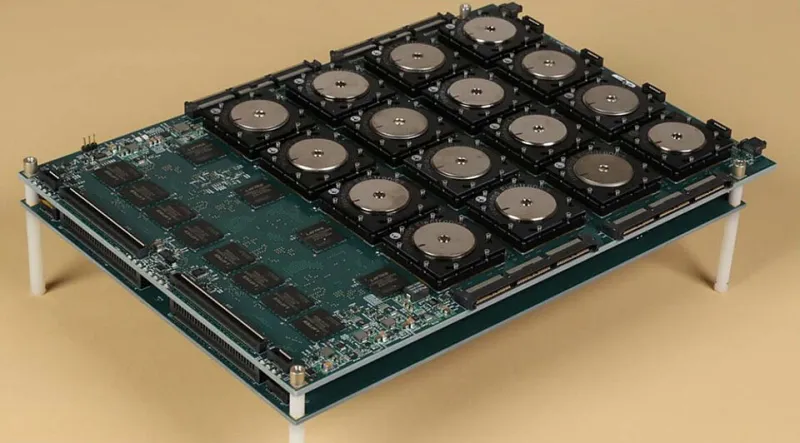
Photo: DARPA SyNAPSE, Public domain, via Wikimedia Commons
Your brain runs on about 20 watts. The server cluster training the AI model that wrote your last email confirmation used enough electricity to power a small neighborhood. Something is deeply wrong with that picture — and a growing group of chip designers think they've found the fix by looking at the one piece of hardware that's been solving intelligence problems efficiently for 300 million years.
Neuromorphic processors are chips that borrow their architecture from biological neural networks. Not metaphorically, the way people say GPUs are "inspired by" the brain. Literally — these chips communicate using spike-based signals that mimic the electrochemical pulses neurons fire, process information asynchronously rather than on a fixed clock cycle, and consume power only when they're actually doing something. They're weird, they're fascinating, and they're quietly showing up in real products right now.
Why Your CPU Is Fundamentally the Wrong Tool for AI
To understand why neuromorphic chips matter, you first have to understand why traditional processors struggle with the kind of tasks brains handle effortlessly.
Conventional CPUs and GPUs are synchronous machines. They operate on clock cycles — billions of times per second, every component in the chip is either working or waiting. They also separate memory from processing, which means data has to constantly shuttle back and forth across a bottleneck called the memory wall. For running spreadsheets or rendering video frames, this architecture is fine. For continuously processing sensory data in real time with minimal power, it's a disaster.
The brain doesn't work this way. Neurons fire only when they have something to communicate — a principle called sparse, event-driven computation. Most neurons are quiet most of the time. When a signal does arrive, it propagates through the network in patterns shaped by previous experience, with memory and processing happening in the same physical substrate. The result is extraordinary energy efficiency for certain classes of tasks: pattern recognition, sensory processing, anomaly detection, real-time control.
Neuromorphic chips try to replicate that architecture in silicon. Instead of transistors flipping between 0 and 1 on a clock, they use artificial neurons and synapses that fire spikes when input crosses a threshold. The chips are asynchronous, event-driven, and — crucially — they use a tiny fraction of the power that a comparable GPU would burn.
Who's Actually Building These Things
Intel's Loihi project is probably the most visible effort in the space. Loihi 2, the second-generation chip, packs about a million artificial neurons and 120 million synapses onto a single chip, and Intel's neuromorphic research lab has been working with universities and companies to find real-world applications. The work is still largely in research territory, but Intel has been more open about Loihi than most chip programs of its kind.
IBM's TrueNorth chip, which dates back to 2014, demonstrated that neuromorphic computing could work at scale — it packed 4,096 neurosynaptic cores onto a single chip consuming just 70 milliwatts. IBM has since moved toward other AI hardware priorities, but TrueNorth remains a landmark proof of concept that the community still references.
The startup side is where things are getting interesting fast. BrainChip, an Australian company with significant US operations, has commercialized its Akida chip — a neuromorphic processor specifically designed for edge AI applications. Akida is already shipping in industrial sensor systems, smart cameras, and robotics platforms. It's one of the first neuromorphic chips you can actually buy off the shelf and drop into a product.
SpiNNaker, developed at the University of Manchester, takes a different approach — it's a massively parallel machine designed to simulate large-scale neural networks in real time, and it's been used for neuroscience research and robotics control systems. The SpiNNaker 2 system is now in the hands of researchers across Europe and the US.
Then there's Innatera, a Dutch startup that's raised significant funding to build neuromorphic signal processors specifically for always-on sensor applications — think wearables that can detect anomalies in physiological data without draining a battery in six hours.
Where They're Actually Being Used Right Now
The applications already hitting the market tend to cluster around a few key areas.
Robotics is probably the most mature use case. Robots need to process sensory data — visual, tactile, proprioceptive — continuously and in real time, and they're often running on battery power where energy efficiency is critical. Neuromorphic chips are a natural fit. Several robotics companies are already using Akida and Loihi-based systems for low-latency motor control and obstacle detection.
Edge AI sensor networks are another big one. Imagine a smart factory floor where hundreds of sensors are monitoring equipment for anomalies 24/7. With a conventional processor, you either burn through power constantly or you miss events by sampling too infrequently. A neuromorphic chip sits in a near-zero-power idle state and wakes up only when something changes — exactly the kind of always-on-but-barely-consuming profile that industrial IoT demands.
Wearables are coming. The energy efficiency story is compelling enough that several wearable health monitoring companies are actively evaluating neuromorphic processors for next-generation devices. If you can run continuous heart rhythm analysis or stress detection on a chip that draws microwatts instead of milliwatts, you're looking at a fundamentally different battery life equation.
Audio processing is already happening. Some voice detection and keyword spotting applications are using spike-based processors because they can sit in ultra-low-power listen mode indefinitely — something that matters enormously for any device where you want always-on voice without plugging in every night.
The Honest Limitations
Neuromorphic computing isn't magic, and it's worth being clear about where it falls short.
Programming these chips is genuinely hard. The spiking neural network models that run efficiently on neuromorphic hardware don't map cleanly onto the deep learning frameworks — PyTorch, TensorFlow — that the entire AI industry has standardized on. You can't just take a trained transformer model and drop it onto a Loihi chip. The software ecosystem is improving, but it's years behind conventional AI hardware in terms of tooling maturity.
For large-scale generative AI tasks — the kind of workloads that made Nvidia a trillion-dollar company — neuromorphic chips aren't competitive. They shine at sparse, event-driven inference tasks, not at the dense matrix multiplications that dominate modern AI training. They're a complement to GPUs, not a replacement.
And the manufacturing ecosystem is immature. These aren't chips you can fab at scale on standard TSMC processes without significant customization, which keeps costs high and volume low for now.
Why It Matters Anyway
Here's the thing: the AI energy problem is real and getting worse. Training GPT-4 reportedly consumed enough electricity to power thousands of American homes for a year. As AI gets embedded into more devices, more sensors, more always-on applications, the idea that we can just keep scaling up power consumption becomes untenable.
Neuromorphic processors represent one of the most credible answers to that problem — not for every workload, but for the huge class of always-on, sensory, real-time tasks that will define the next wave of intelligent devices. The brain figured out how to do this efficiently a very long time ago. It's taken silicon a while to catch up.